The Soul of Bali: Culture, Traditions, and Secrets about the Island of the Gods
En este artículo
- Introduction
- From the “Island of the Gods” to the “Island of the Thousand Temples”
- The System of Three Community Temples (Kahyangan Tiga)
- Spirituality and traditions in everyday life
- Daily Devotion: The Significance of Offerings
- The experience of Kuningan: when ancestors return to the spiritual world
- The heart of the home and family structure
- Behind the Smile: The Story of Indonesia and the Balinese Spirit
- Whispering Secrets: Life in Community (Banjar)
- Environmental Myths, Preconceptions, and Challenges in Bali
- Myth 1: “Bali is just a postcard paradise of beaches”
- Myth 2: “It’s a purely commercial and hyper-touristy destination”
- Myth 3: “It’s a perfect retreat from peace, silence, and purity”
- A conscious glance: Environmental and social challenges
- Practical details for a respectful trip
- Frequently Asked Questions about Culture in Bali (FAQ)
- What if I accidentally step on a Canang Sari offering in Bali?
- Can I participate and take photos during religious ceremonies and processions?
- What religion and language are spoken in Bali?
- Planning Your Route in Bali? You Might Also Be Interested In
How is culture in Bali? Journey to the essence of God’s Island
To answer this question, we traveled for 1 month and a half to the Island of Bali in Indonesia, to learn about its traditions, religion, and way of seeing the world.
Introduction
I close my eyes and enjoy the warm breeze that comes from the Balinese jungle; it caresses my face softly and reminds me how fortunate I am. The sound of the waterfall harmonizes with birds and insects, creating a sublime melody. It reaches the doorstep of our accommodation, a guest house where a lovely local family welcomes us cheerfully into their home.
After spending a few days in Ubud’s center, wandering its lively and noisy streets, discovering the Ubud Palace, Monkey Forest, and nearby temples, we started our second journey stage. For me, this means writing down all the stories I’ve been rehearsing in my mind and keeping them dear to my heart. We found the perfect spot on the outskirts of Ubud that combines beauty and calm with the possibility of fulfilling our digital work objectives. Joy overflows in our hearts, which is why I’m sharing the learning about fascinating Balinese culture up until today.
From the “Island of the Gods” to the “Island of the Thousand Temples”
Bali is popularly known as the Island of the Gods due to its permanent spiritual devotion and belief that deities and spirits inhabit every corner of nature. However, it’s also nicknamed the Island of a Thousand Temples, a name that’s far from an exaggeration.
The System of Three Community Temples (Kahyangan Tiga)
In Bali, there is no village without shrines. Beyond the small family altars that each home harbors in its patio, every traditional village (Desa Adat) is structured in a sacred way under the concept of The Three Temples (the three community temples), dedicated to the Hindu trinity (Trimurti):
- Pura Puseh (The Temple of Origin): Dedicated to the god Brahma (creator). It is oriented towards the sacred mountains (Kaja) and honors the founding ancestors of the village.
- Pura Desa (The Community Temple): Dedicated to the god Vishnu (preserver). Located in the center of the village, it is the space where neighbors gather to resolve community matters and celebrate collective rituals.
- Pura Dalem (The Temple of Death and Reincarnation): Dedicated to the god Shiva (destructor/transformer). Situated towards the sea or lowest zone (Kelod) near the cemeteries.
Spirituality and traditions in everyday life
Daily Devotion: The Significance of Offerings
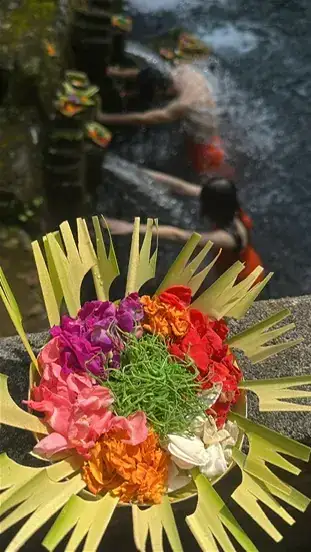 Ofrendas diarias Balinesas Canang Sari
The Balinese population surprised us with their charm and friendliness. They have a different lifestyle paradigm, faithful to their traditions, performing their gratitude and connection rituals multiple times a day in their family temples. These offerings, known as Canang Sari, are the spiritual heartbeat of the island. It’s a small handmade basket woven with banana or palm leaves, filled with specific color flowers according to sacred directions: white to the east, red to the south, yellow to the west, and blue or green to the north.
They are always accompanied by a fragrant incense with which they briefly circle around using a subtle movement of the hand; a gesture intended to purify the space before elevating their prayer. Additionally, on certain occasions after the prayer, they place damp rice grains (Bija) on their forehead or chest, symbolizing the seed of life and divine blessing.
Gods, demons and music in the streets
As you walk, it’s common to be surprised by the masks and stone statues that seem like guardian demons. Balinese Hinduism is unique; while they share deities like Brahma, Vishnu, and Shiva with Indian Hinduism, syncretism is their own. Not attempting to represent gods in human form, they draw on the power of nature and mythology.
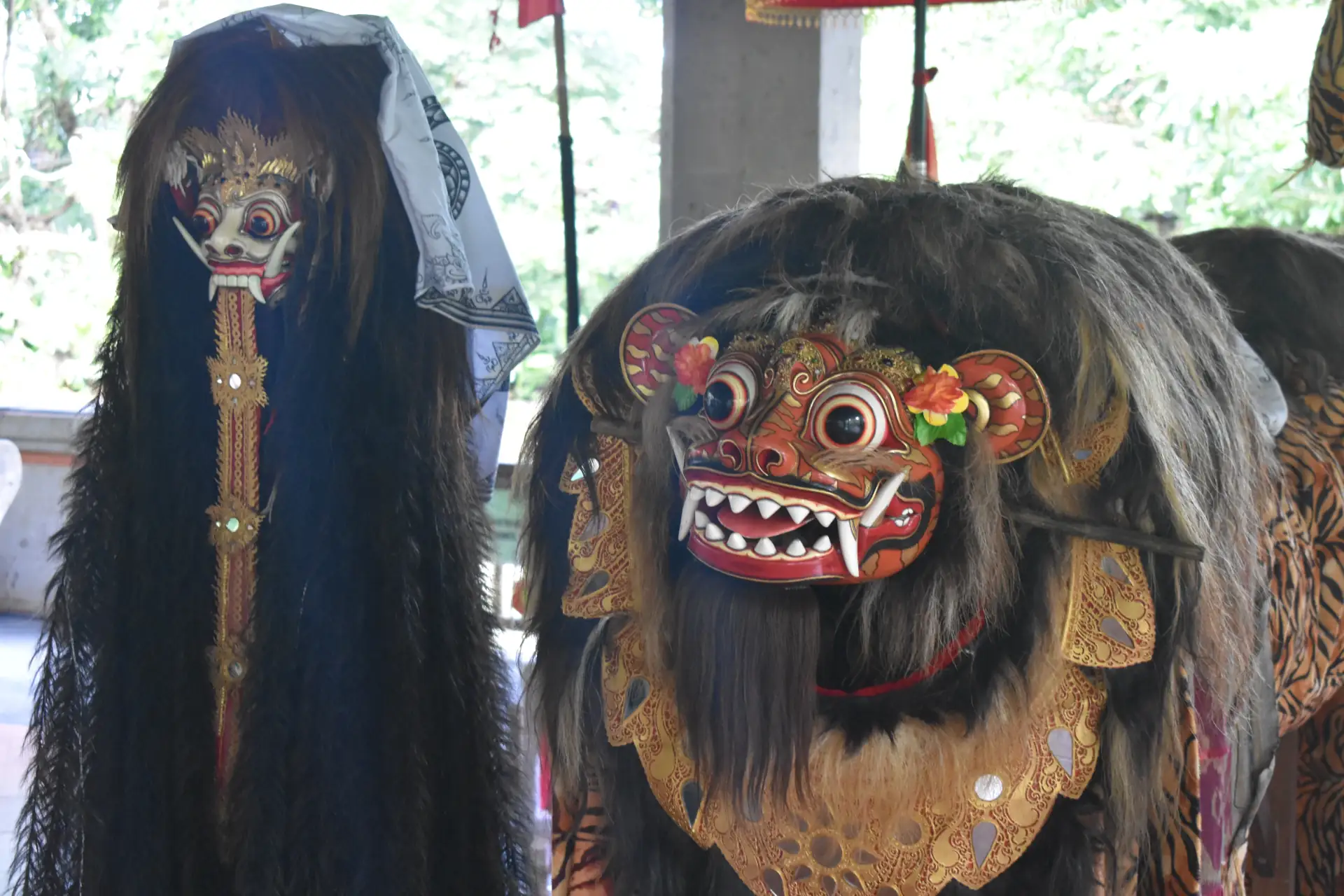 Representación de dioses en forma de animales, Hindu Bali
It’s common to walk through the streets and run into Banjar, the community organization of the neighborhood. A group of young people walks with their traditional instruments (the Gamelan: metalophones, gongs, and drums) to offer blessings and receive coins. Among them stands out the Barong, a protective figure (a long costume with monkey or tiger face, among others) that dances in time to the percussion, directed by two people inside it. Families come out to accompany them and children applaud urging on the sidewalks.
The experience of Kuningan: when ancestors return to the spiritual world
I had the fortune of arriving in Bali near the Kuningan, a celebration that occurs every 210 days according to the Balinese cycle. This festival marks the end of the Galungan cycle, and it is said that this is the moment when ancestors return to the spiritual world after visiting their families.
The word Kuningan comes from kunyit (turmeric), the star of yellow rice prepared for gods and served with coconut on banana leaves. The ceremony symbolizes the victory of Dharma (good) over Adharma (chaos). During the preceding days, the neighborhood transformed: families worked together preparing decorations with coconut leaves, banana, and flowers.
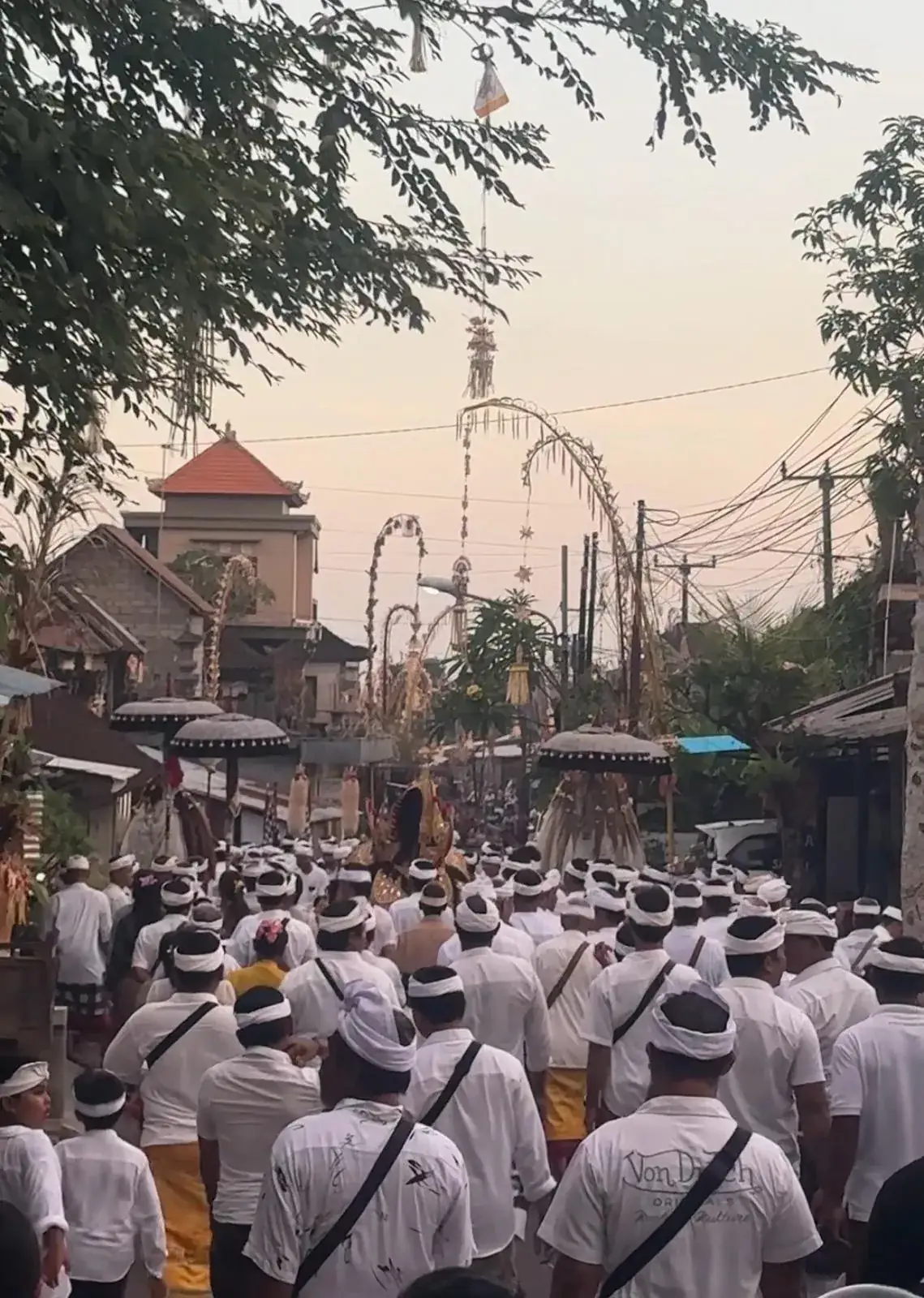 Ngelawang, marcha por la villa en Galungan y Kuningan
On the day of the ceremony, in the morning, women walked to the neighborhood temple carrying Gebogan (giant fruit and flower towers) on their heads. The rest of the day was spent between visits to neighbors’ temples and family ceremonies at their own temples. In the afternoon, a large procession of people dressed in white, with their sarongs and shiny blouses, walked through the streets exchanging greetings and conversations. They accompanied each other, laughed, and made jokes; every elderly woman would invite babies from the neighborhood who were watching as their parents to join in, because, as Wayan told us: “In each neighborhood we know each other, we’re friends and take care of one another.”
Entranced, she walked and observed how the ceremony was unfolding. Leading the procession was the Barong (the protective figure of the village that brings blessings), which stopped every few blocks; the ladies would make offerings through a ritual and it would dance, bestowing blessings to the rhythm of the Gamelan. Being part of something so big felt incredible and also made me reflect on the sense of community. In Bali, this isn’t just an abstract concept or an idea: it’s a tradition, a living practice.
Everyone takes care of the environment and others. The neighbors organize with rotational roles to take care of maintenance and community needs, Wayan told us. Rituals, care, family, and tradition are very integrated parts of Balinese culture. To be honest, it seemed very beautiful and inspiring; seeing people in the street laughing, chatting, working many times, but enjoying together confirmed my previous feeling about this trip: community saves, generates joy, and prevents that existential void, that loneliness we talk so much about in the West.
The heart of the home and family structure
The architecture of traditional houses responds to this philosophy of harmony. A family complex is not a single closed house, but rather consists of several pavilions in the open air. They always have a Sanggah, the private family temple oriented towards the sacred mountain. Upon crossing the threshold, it’s common to come across the aling-aling, a small wall that blocks the entrance to confuse evil spirits, as it is believed only they can move in a straight line.
The family is the axis. The siblings are named in order of their birth:
- Wayan: The eldest brother or sister.
- Kadek (or Made): The second one.
- Komang (or Nyoman): The third one.
- Ketut: The fourth one.
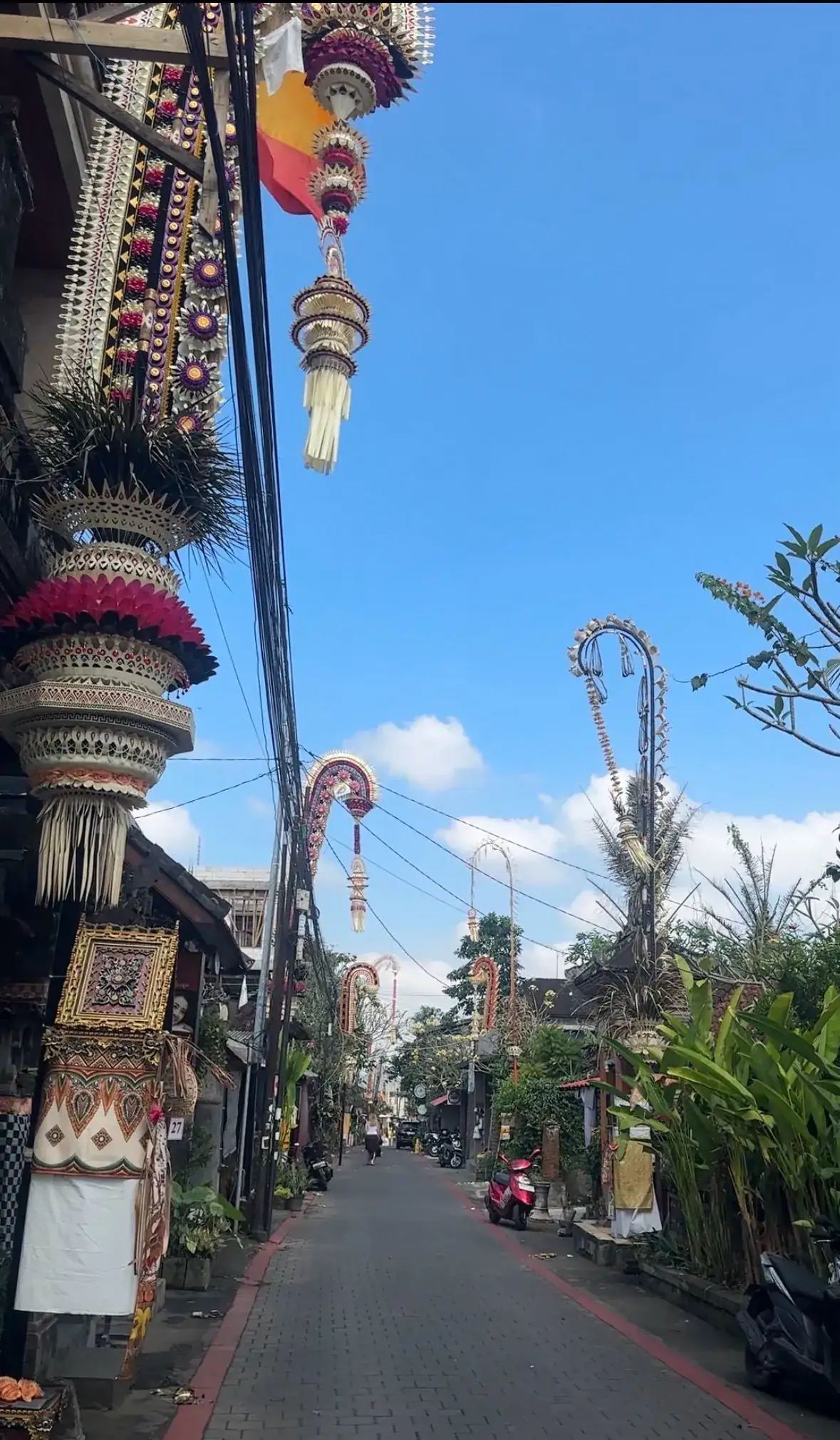 Penjor de bambú decorado en Bali durante el festival de Kuningan. Simbolizan la gratitud hacia laos dioses, la tierra y las montañas sagradas.
In each Balinese home where we’ve stayed, a family lives together: grandmothers, mothers, uncles, cousins, and children. One thing is clear: family life in Bali is a cultural and symbolic axis.
Investigating a bit, we discovered that the culture is marked by a strong patrilineal tradition. In the rituals we know as “wedding” (Mepejati), the bride formally says goodbye to her ancestors at the family temple where she grew up and is “received” or adopted into the ancestral temple of her husband’s family. From that moment on, she becomes part of his lineage and acquires religious and social responsibilities in her new home and banjar. It’s more than just a change of address: it’s a spiritual and social transition. However, there is an exception (beautiful, in my opinion): when a family only has daughters, the ritual Nyentana is celebrated, where it is the groom who moves into the woman’s home and, thereby, preserves the lineage and care for the elderly members of the family. It’s an example of how Balinese culture finds ways to honor continuity and balance.
Behind the Smile: The Story of Indonesia and the Balinese Spirit
Chatting with Roi, a local guide from the island of Java that we met upon arrival, we were able to understand that such warmth is also a product of a story of resistance. He was telling us how Indonesia was colonized and enslaved by the Dutch for over 300 years, a period of massive resource extraction that allowed the Netherlands to position themselves as one of the most influential economic and commercial powers in Europe.
After this period came the Japanese occupation (1942-1945), which was a very harsh time, although he refers to it as “better” in terms of knowledge acquisition for the local population. I found his perspective interesting, like that of someone who sees the past as a scar from which they learned. But upon further inquiry, we discovered that Bali has its own chapter: it was the last island to fall under colonial rule. At the beginning of the 20th century, in response to Dutch invasion, the Balinese people staged the Puputan: when they saw the Dutch ships approaching, they performed a collective ritual suicide as nobles and their subjects, who preferred to die rather than surrender to slavery and exploitation.
This story of resistance turned Banjar into the heart of Bali. More than a community structure, it’s an invisible network of containment where rituals and territorial care are taken on as a collective commitment.
Whispering Secrets: Life in Community (Banjar)
In a fragmented Western world isolated by solitude, Bali offers an interesting reflection. Perhaps the secret to its happiness is a practice in full view: maintaining and valuing the encounter as part of daily life, whether through spontaneous chat on the sidewalk, shared work, or shared ritual and ceremony. Maybe Balinese happiness isn’t an individual search, but a consequence; an invitation to remember that no one inhabits the world alone and that everything takes shape in relation with others.
Environmental Myths, Preconceptions, and Challenges in Bali
Before traveling, it’s normal to arrive with preconceived notions shaped by social media or commercial guides. However, the real Bali is much more complex and fascinating:
Myth 1: “Bali is just a postcard paradise of beaches”
The reality is that Bali is a volcanic island. While the south (Uluwatu) stands out for its dramatic cliffs and epic waves for surfing, the beaches on the east and north (such as Amed) are black volcanic sand beaches with calm waters ideal for snorkeling. The true spiritual heart of the island isn’t at the beach, but in the jungle, volcanoes, and rice fields. You can also find spectacular beaches in areas like Nusa Penida or Virgin Beach
Myth 2: “It’s a purely commercial and hyper-touristy destination”
Although areas in the south concentrate massive beaches and nightclubs, authentic Bali hasn’t disappeared: you have to go out looking for it. Just head 15 or 20 minutes away from the main avenues to find rural tranquility, small family residences, and an intact pace of life. It also depends heavily on which zones you choose to visit, for example Amed zone or Seminyak is more tranquil than other areas with higher tourist traffic like Kuta or Canggu, you can delve deeper into this in our article [Traveling to Bali in 2026: Requirements, Transportation, and Staying Zones.]](https://blogcito.com/diario/2026-06-18-bali-bby-1/)
Myth 3: “It’s a perfect retreat from peace, silence, and purity”
It’s far from the Western image of calm and perfection with white suits and impeccable streets everywhere; the concept of spirituality and culture here is genuine, everyday, and native to this territory. Bali is vibrant, noisy in its urban centers and full of social life. If you’re looking for absolute silence, the best experience is living through Nyepi (Bali’s Day of Silence), where the entire island turns off lights, halts traffic, and even shuts down its airport for 24 hours.
A conscious glance: Environmental and social challenges
Visit the island with respect also implies recognizing its current challenges. The rapid tourism growth brought a serious waste management problem of plastic residues that affects its rivers and coasts (although it’s worth noting this is not an exclusive problem of this island). Similarly, a marked socio-economic gap exists between luxury villas and the simple reality of rural families or economic problems due to resource scarcity such as children and girls selling brooches to pay for school materials. Although no one is obligated to save the world, there are small actions to travel responsibly that can generate a small impact like consuming locally, reducing single-use plastics, respecting locals’ routine and traditions.
Practical details for a respectful trip
- In temples: It is mandatory to cover your shoulders and legs with a sarong to enter any sacred space or government office, for both men and women.
- On streets: Offerings are everywhere. Intentionally or carelessly stepping on them is considered disrespect. Paying attention and dancing to avoid them is a necessary practice.
- Accommodation: Booking in family-run residences or guest houses allows for a more authentic experience, directly supporting the local economy.
Basic Glossary of Everyday Expressions in Bali
| Español | Balinés local | Inglés | Indonesio (Bahasa) |
|---|---|---|---|
| Hola / Saludo | Om Swastiastu | Hello | Halo / Selamat pagi |
| ¿Cómo estás? | Kenken kabare? | How are you? | Apa kabar? |
| Bien, ¿y vos? | Becik, kenken kabare? | Good, and you? | Baik, kalau kamu? |
| Gracias | Suksma | Thank you | Terima kasih |
| Por favor / De nada | Nunas / Suksma mewali | Please / You’re welcome | Tolong / Sama-sama |
Frequently Asked Questions about Culture in Bali (FAQ)
What if I accidentally step on a Canang Sari offering in Bali?
Apologize with respect and a smile (a “Suksma” or friendly hand gesture) 🙏. Don’t worry too much and make sure to be mindful of your walking, especially near house and store entrances.
Can I participate and take photos during religious ceremonies and processions?
Yes, in our experience they are very hospitable and open to sharing their festivities. In public processions and rituals, including, you can participate by wearing the appropriate attire sarong and covered shoulders. However, generally speaking, access to temples is not allowed during celebrations.
What religion and language are spoken in Bali?
Unlike the rest of Indonesia (predominantly Muslim), more than 86% of Bali’s population professes Balinese Hinduism. As for languages, the official language of education and commerce is Indonesian (Bahasa Indonesia), but in daily life and at home everyone speaks Balinese (Bahasa Bali).
Planning Your Route in Bali? You Might Also Be Interested In
If you want to keep organizing your trip to the island and combining cultural experiences with coastal and practical destinations, don’t miss our recommended guides:
- 🌿 What to do in Ubud: A complete guide to culture, temples, and costs
Discover the cultural capital of Bali, its rice terraces, waterfalls, and traditional dance shows. - 🌊 Amed, Bali: A real guide to slow travel, snorkeling, and budget 2026
Get to know the fishing village on the eastern coast, its black sand beaches, and the best snorkeling spot on the island. - 🛵 Traveling to Bali in 2026: Requirements, transportation, and areas to stay
The practical guide with everything you need to know about visas, how to get around, and tips before landing.