Buying a Campervan or Car in New Zealand: A Guide to Not Dying in the Attempt
En este artículo
- Key Concepts: Vehicle Papers in New Zealand Explained:
- 1. WOF (Warrant of Fitness): Your car’s health check
- 2. REGO (Registration): The mandatory traffic circulation tax
- 3. How to put your car in your name? The change of ownership procedure: Simple and fast
- 4. Auto Insurance: What You Need to Know for a Peaceful Journey
- Who to Buy From? Dealer vs. Private Seller
- Essential Checklist: 4 Mechanical Tests for a Car That Works
- 1. The Olive Twig Test
- 2. The Escape Channel (The Color of Smoke Has Data)
- 3. The Oxide Test
- 4. The distribution belt (The famous “Timing Belt”)
- Under the Hood: The Mechanical Exam by AAA
- Your rights by law: The WOF 28 days prior to purchase
- The 28-Day Rule of WOF
- Having trouble with your car? Your lifesaver: The Citizens Advice Bureau (CAB)
- A final travel tip
- Buying Your First Car Abroad: A Mix of Pure Adrenaline, Excitement, and a Hint of Fear
Our dream when we arrived was to buy a van in New Zealand, live a dreamed adventure in the mountains, wake up with epic views and enjoy soft breeze afternoons. Many travelers dream of that road trip but clearly without being ripped off in the attempt; let’s be realistic - most of us who travel on a Working Holiday visa aren’t professional mechanics.
At the beginning I simply went to see the cars and looked confused trying to get something clear out of it but by the end of the trip, in addition to fulfilling the dream of a road trip, we had a very wild and complex experience with a camper that was burning oil. It turned out to be a huge headache, but the truth is that New Zealand’s laws protected us and in the end everything went well. In fact, that’s my inspiration for writing this post: informing to prevent others from avoiding a bad experience when buying a car and sharing all we were learning on the way.
In this post you will find basic information about concepts, legal procedures, and recommendations that you should know before buying a car in New Zealand in 2026, along with a checklist of mechanical tips to evaluate a car at the time of purchase based on our personal experience and checked information.
Key Concepts: Vehicle Papers in New Zealand Explained:
1. WOF (Warrant of Fitness): Your car’s health check
Vehicle Safety Certification
Below I will elaborate on this crucial point but essentially, it is the mandatory technical review that certifies the vehicle is safe to circulate on the street (brakes, lights, tires, seatbelts and chassis structural rust).
The validity periods vary depending on the age of the document:
- If the car was registered as of January 1, 2000: The WOF is valid for 12 months.
- If the car is older (model 1999 or earlier): The inspection is ultra strict and mandatory every 6 months.
2. REGO (Registration): The mandatory traffic circulation tax
It’s the obligatory road tax (license plate). It’s a paper sticker that’s stuck on the windshield (lower left, passenger side) and shows its expiration date. Essentially, it’s what you pay the government to have the right to use the highways. It costs around $100 NZD per year and you can renew it for 3, 6 or 12 months through the same channel.
Attention: Before transferring the car, carefully examine the label to avoid inheriting debts: If the previous owner allowed the Rego to expire three months prior and you buy the car, the debt becomes yours. When you go to the post office, the system will force you to pay those overdue months.
The 12-month limit: If a car passes more than a year with the Rego expired, the government removes it from the system and takes away the plates. Re-registering it is a headache and costs money, so if the Rego has been expired for many months, better look for another option.
3. How to put your car in your name? The change of ownership procedure: Simple and fast
To make the change of ownership in person, you can go to any local post office (PostShop), an authorized Automobile Association (AA) branch for vehicle title transfer or a VTNZ center.
- What to bring: Your passport, your country’s driver’s license (along with its official translation or international driving permit) and NZD $15.
- The Form: Upon arrival, you’ll find the MR13B Form (Notice to buyer of registered motor vehicle). You fill it out in two minutes with your information, the seller’s details, and the car’s info, then hand it in at a window, pay, and you’re done.
- By law, they also need to notify that they sold the car by filling out another form (the MR13A). Remember to remind them to do so on the same day so that the transportation system (NZTA) can correctly cross-check the data (it can be done online).
4. Auto Insurance: What You Need to Know for a Peaceful Journey
Unlike many of our countries, in New Zealand car insurance is not mandatory by law, but traveling without it in my opinion is madness. There are three types of coverage, but for the backpacker’s budget, the basic and essential option is Third Party Insurance (Third Party Liability). This insurance doesn’t cover damages to your car, but it does pay for repairs to the vehicle you hit if the accident was your fault. Companies like AA or AMI let you sign up online in five minutes and pay monthly for very few dollars.
Who to Buy From? Dealer vs. Private Seller
I chose the first one thinking it would be a guaranteed option. Although we had several problems with the camper, the truth is that the law protects you quite well in case the situation was very unfavorable for you, as long as you have a long administrative process if you can’t reach an agreement with the seller and you must be very careful with the vehicle. But here’s a brief summary of the differences on who to buy from:
If you buy from a Registered Motor Vehicle Trader (Dealer): By law, they are required to display the Consumer Information Notice (CIN) on the car window. This official document guarantees that the mileage is real, that the car has no outstanding debts and isn’t stolen. Additionally, you’re protected by the Consumer Guarantees Act.
If you buy from a private individual (another traveler or local person): Consumer law doesn’t protect you in the same way. Here, it’s your responsibility to investigate. Before meeting with the seller, check Car Jam’s page, enter the license plate number and some information will appear for free or you can purchase the complete report for just a few dollars. It will instantly tell you if the car has pending debts, fines, or loans (finance).
Essential Checklist: 4 Mechanical Tests for a Car That Works
1. The Olive Twig Test
I opened the hood and look for the oil dipstick (it usually has a brightly colored plastic ring). Take it out, wipe it with a paper, put it back in and take it out again:
- Level: The oil level should be between the two marks on the dipstick. If it’s below, that’s a bad sign (the owner is neglectful).
- Color: It should be golden or translucent brown. If it’s black carbon, it needs an urgent change.
The dreaded “mayonnaise”: When you open the cap where oil is loaded into the engine and look at the internal part of the ring. If you see a creamy paste in a light brown or beige color (similar to mayonnaise) it means the coolant is mixing with the oil because the head gasket is broken. Fixing that will cost you more than the car itself (note: this information was extracted from the internet, I’m not an official mechanic, honest).
2. The Escape Channel (The Color of Smoke Has Data)
Here’s what happens when you start the engine and accelerate a bit at idle: look out for smoke coming out of the exhaust pipe.
The smoke speaks directly about the health of the engine:
- Thick white smoke: If it’s a fine thread that disappears in a few minutes on a cold morning, it’s just normal condensation. But if it’s thick, constant white smoke with a sweet smell, the engine is burning coolant.
- Blue or grey smoke: The engine is burning oil. It usually stems from worn piston rings or seals. It’s an expensive repair; my suggestion is don’t get in there without consulting an expert (or why would you buy one).
- Black smoke: It means it’s burning too much fuel. It can be just a clogged air filter or dirty injectors. In older cars that use diesel, it’s common when accelerating hard, but if it’s excessive and constant, the car won’t pass its next WOF and you’ll have problems reselling it.
3. The Oxide Test
In New Zealand, rust is the number one enemy of cars due to the saltiness of the sea. Crouch down and take a look at the chassis (the metal structure below) and the edges of the wheels. If you see superficial rust stains, nothing’s wrong; but if the metal is flaking off or falling apart when you touch it, that car won’t pass the WOF. In this country, they’re strict about structural safety and repairing rust on the chassis requires certified welders (a significant investment in repairs).
4. The distribution belt (The famous “Timing Belt”)
When was the timing belt changed? The distribution belt is what makes the engine work in sync. If it breaks while driving, the engine will be destroyed instantly. It usually needs to be replaced every 100,000 kilometers. To check, look for a physical sticker on the engine that indicates the date and mileage of the last change or ask. If your car has 220,000 km and the decal says it was changed at 100,000, you’ll need to replace it soon (An extra $500 to $800 NZD in expenses).
Under the Hood: The Mechanical Exam by AAA
The largest insurance company in NZ has an inspection service and, although they don’t take sides in case of claims, they are very professional with their work. You can book online and there is one in almost all major cities in New Zealand.
Pre-Purchase Vehicle Inspection (Automobile Association prior purchase inspection) or alternatively, conducting one within the next 48 hours after purchasing the vehicle.
How does it work?: You can agree with the seller that you’ll pay for the inspection (costing between $130 and $210 NZD, depending on the type of vehicle).
Your rights by law: The WOF 28 days prior to purchase
New Zealand is a very organized country, and its legislation protects the buyer quite well, but you need to have clear information. Two points that are good to know:
The 28-Day Rule of WOF
By law in New Zealand, when someone sells you a vehicle, it must have a Warrant of Fitness (WOF) issued within the past 28 days at the time of delivery and is credited through a physical adhesive sticker (sticker) that is stuck obligatorily to the upper corner of the windshield (driver’s side).
The WOF is New Zealand’s legal vehicle control system. What it does is certify that the vehicle meets the minimum safety standards for highway use without posing a risk to you or others. In other words, it checks that the brakes respond, the lights work, the tires have suitable tread, the seatbelts are securely fastened, and there is no rust in the chassis structure.
But be careful: the WOF is not a guarantee of mechanical health. It doesn’t control whether the engine is worn out, if the gearbox will break tomorrow, or if there are oil leaks. A car can pass the WOF perfectly and have its motor on the verge of dying. That’s why I would recommend combining the WOF with the AAA’s prior checkup.
The key is to find a car that’s practical for your travel objectives and won’t be a headache to travel with, so it’s necessary to ask key questions like:
Fuel consumption, insulation for cold weather, if the air conditioning works, if you have real space for luggage, if it’s comfortable for daily use, if the engine has power for steep inclines, if it’s resellable in relation to mileage.
Having trouble with your car? Your lifesaver: The Citizens Advice Bureau (CAB)
Sometimes, despite taking all precautions, things can go wrong. If you discover that you were sold a car with a hidden major problem or they lied to your face outright, don’t just fold your arms. The complaint processes can take up to 3 months and involve a long administrative process, but there is the CAB (Citizens Advice Bureau), which for example in South America would be known as a citizen’s defense office or advocacy. Our experience with them was totally favorable: they listened to us, informed us, helped us organize our documentation, and accompanied us via email throughout our complaint. To be honest, it’s ideal not to need them, but if you do, we’re deeply grateful to the lady who helped us at the Queenstown office.
The CAB is a completely free, confidential, and independent national service. They have physical offices in almost every city in New Zealand and attend to you with an incredible human warmth (including translators if explaining your situation in English gives you jitters).
The guide will walk you through step by step on how to behave:
If You Bought It from a Dealer: They will help you draft a formal complaint under the Consumer Law via mail, and if the seller doesn’t respond, to take the case to the Motor Vehicle Disputes Tribunal (MVDT) for a very low fee (around $87 NZD). This tribunal has the legal power to compel the dealer to reach a favorable agreement.
If you bought it from a private individual: Although it’s harder, if you have proof that the seller actively deceived you, CAB advisors will help you file a complaint at the Disputes Tribunal (common disputes tribunal). In our experience and according to what we’re told, justice here works, is accessible, and you don’t need to pay expensive lawyers to uphold your rights.
A final travel tip
Buying Your First Car Abroad: A Mix of Pure Adrenaline, Excitement, and a Hint of Fear
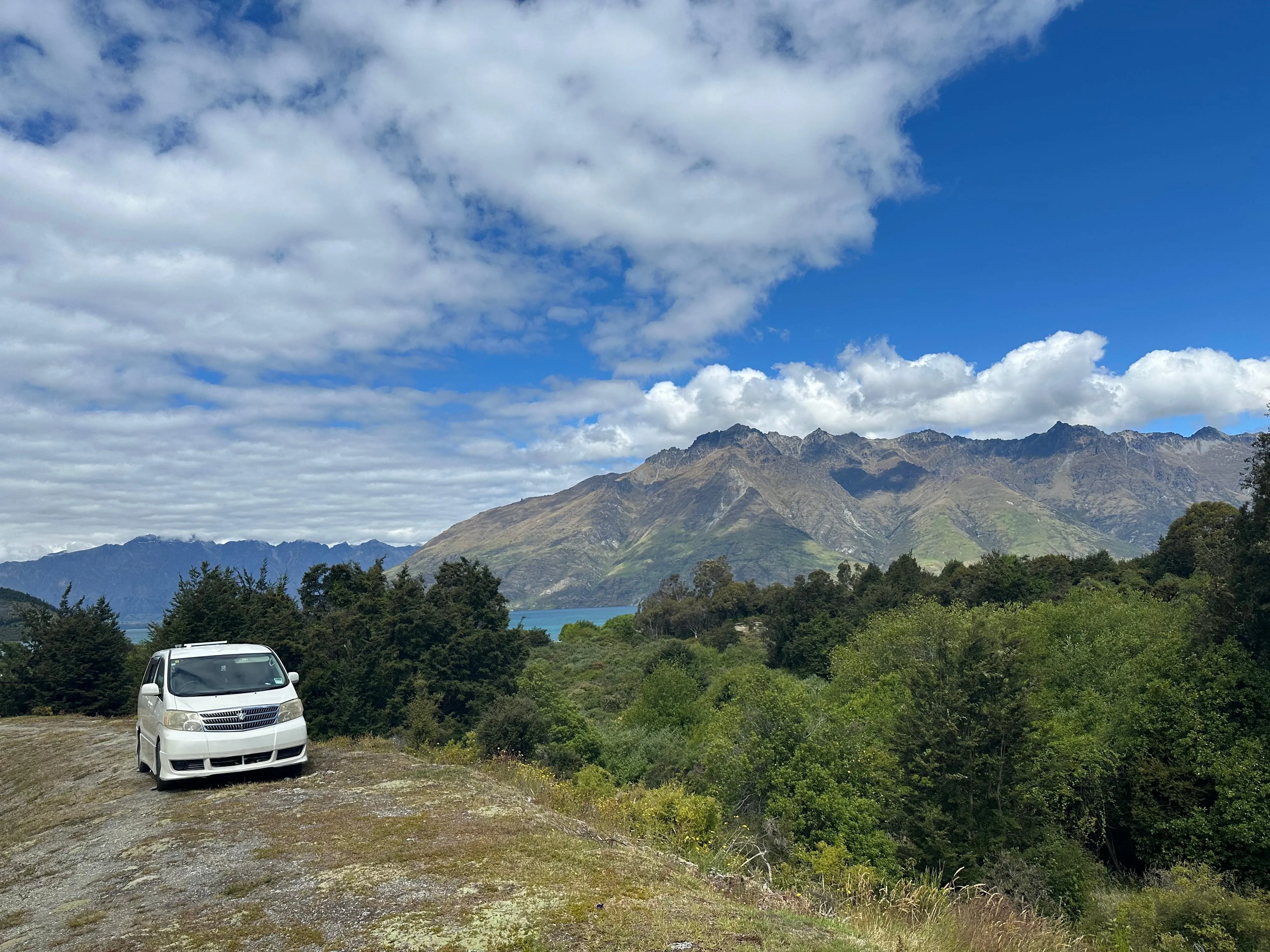
Buying your first car abroad is a mix of pure adrenaline, excitement, and a hint of fear. That camper van will be your home for a while, during the adventure in a country that’s ready to make it epic.
 Vista desde la camper en Bowentown Look Out
It’s a mobile camping experience, a shelter for rainy nights and the best hotel to wake up with the best mountain views; literally it’s a passport to freedom on New Zealand’s roads. Because it’s such a lovely dream and an experience I highly recommend, take your time, read, research, consult people who know. Don’t let the salesperson rush you, don’t fall in love with the first car that catches your eye and always trust your intuition. The market is huge and the ideal car for your route is waiting somewhere out there. Good luck on your search and if you’re in the process or have doubts about something, don’t hesitate to leave a comment below. If we help each other, we’ll have more chances of living the dream and fewer nightmares.
Cheers!